
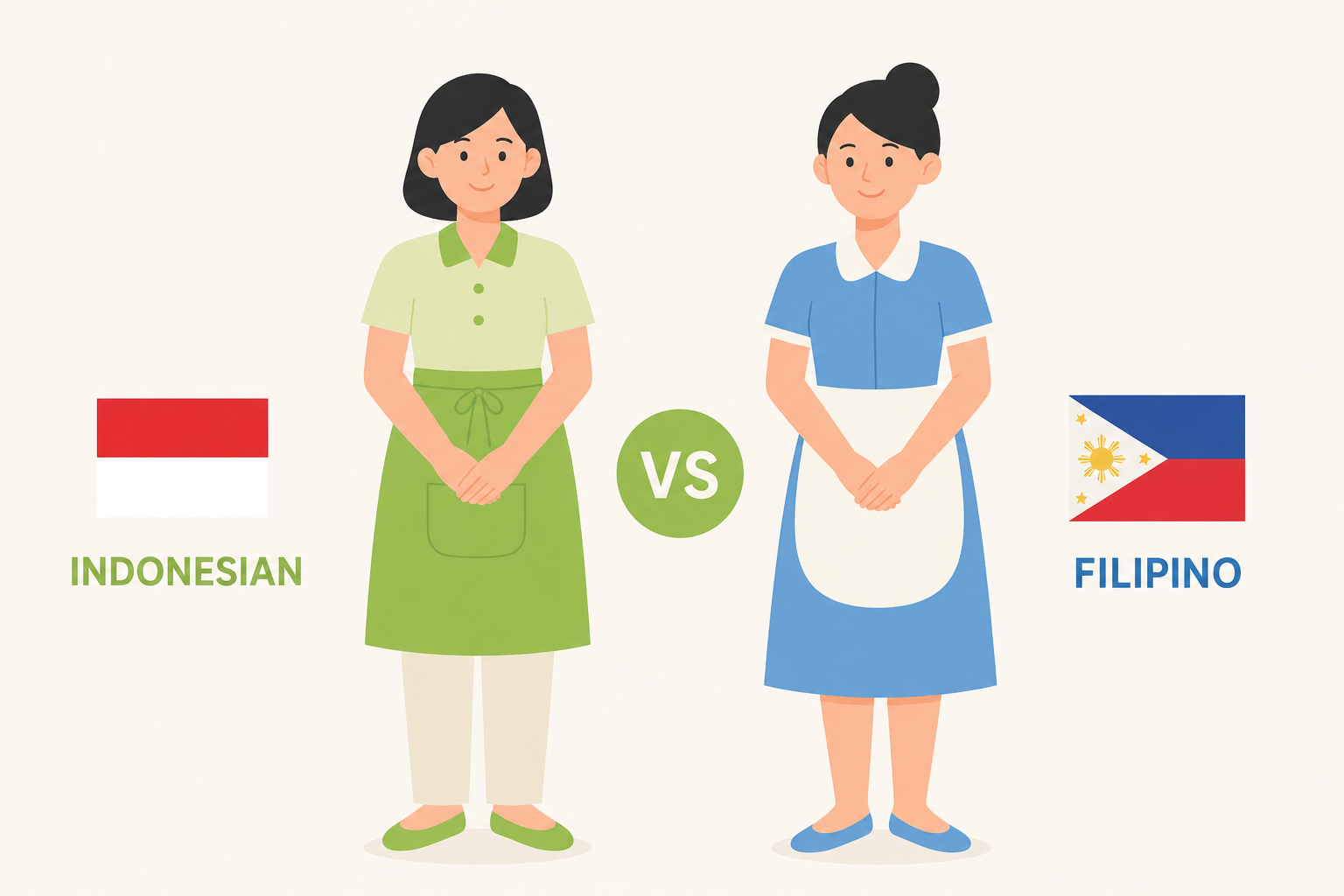
This is one of the most common questions Klang Valley families ask when starting their search. Indonesian or Filipino? The honest answer is that neither nationality is universally better — but one may be significantly better for your specific household. Here's how to think about it.
Why Nationality Matters - and Why It Isn't Everything
Nationality influences language background, cultural norms, salary expectations, and the legal framework governing a helper's placement. These are real differences worth understanding. But within any nationality, individual temperament, experience, and fit with your specific household varies enormously. A poorly matched Filipino helper and a perfectly matched Indonesian helper are not interchangeable - and vice versa.
The goal is to use nationality as one input in a broader assessment, not a shortcut that replaces it. At Jaya Persona, we assess both - we source from both countries and recommend based on your household's specific profile, not on which nationality is trending.
Indonesian Helpers: Strengths and Considerations
Indonesian domestic helpers make up the majority of the domestic helper workforce in Malaysia, and for many households they are an excellent fit.
- Language compatibility. Bahasa Indonesia and Bahasa Malaysia are closely related. Communication with Malay-speaking families is generally smooth from day one, without a significant adjustment period.
- Cultural and religious alignment. For Muslim households, Indonesian helpers typically share halal dietary practices, prayer routines, and cultural sensitivities around illness and family life.
- Lower cost. Monthly salary expectations and one-time placement costs are generally lower than for Filipino helpers. No Settling-in Programme (SIP) fee applies.
- Wide availability. Indonesia is Malaysia's largest source country for domestic helpers, meaning more candidates and shorter placement timelines in most cases.
Things to verify: Specific eldercare or infant care experience must be assessed individually - not assumed based on nationality. Language compatibility with Cantonese or Tamil-speaking elderly family members may require specific assessment.
Filipino Helpers: Strengths and Considerations
Filipino domestic helpers are widely regarded for their English proficiency and experience in formal caregiving roles.
- English language skills. Most Filipino helpers are conversational to fluent in English. For households where the family communicates primarily in English, or where children need English exposure, this is a significant advantage.
- Formal caregiving training. The Philippines has a strong culture of professional caregiving training. Many Filipino helpers have formal certifications in eldercare, infant care, or nursing assistance.
- High initiative and communication. Filipino helpers are generally more likely to proactively communicate, flag issues, and take ownership of their responsibilities - a trait many families value highly.
- International experience. Many Filipino helpers have previously worked in Hong Kong, Singapore, or the Middle East, bringing broader household management experience.
Things to consider: Higher salary expectations and the mandatory SIP fee increase total costs. Cultural and dietary alignment with non-English-speaking or Muslim households requires specific assessment.
Side-by-Side Comparison
| Factor | Indonesian | Filipino |
|---|---|---|
| Language (Malay) | High compatibility | Limited - English primary |
| Language (English) | Variable | Generally strong |
| Religious alignment (Muslim HH) | High (majority Muslim) | Low (majority Christian) |
| Eldercare/caregiving training | Variable - must verify | More commonly certified |
| Monthly salary range | RM1,500 – RM1,800 | RM2,100 – RM2,500 |
| One-time placement cost | Lower | Higher (includes SIP) |
| Availability | High | Moderate |
Which Should You Choose?
Use this as a starting framework:
- If your household communicates in Bahasa Malaysia, and especially if it is a Muslim household, an Indonesian helper is often the smoother cultural fit.
- If English communication is important - whether for childcare, elderly patients who speak English, or your own household - a Filipino helper is likely the stronger choice.
- For eldercare involving dementia or post-stroke patients, verify caregiving experience directly regardless of nationality.
- If cost is the primary constraint, Indonesian helpers offer a lower total cost of placement and employment.
For a full breakdown of placement costs by nationality, see our 2026 maid agency cost guide. For legal requirements around hiring from either country, see our PLKS work permit guide.
Frequently Asked Questions
Neither is universally better. Filipino helpers tend to have stronger English skills and more formal caregiving training. Indonesian helpers tend to offer better Malay language and cultural alignment for Muslim households. The right choice depends on your specific household needs.
No. The Settling-in Programme (SIP) is mandatory for all new Filipino domestic helpers deployed to Malaysia as required by the Philippine government. It costs RM750 and is typically arranged by the agency.
Both nationalities can provide excellent eldercare when matched correctly. Filipino helpers are more likely to have formal caregiving certifications. Indonesian helpers may be the better fit for Malay or Muslim elderly patients who prefer cultural familiarity. In both cases, verify specific eldercare experience before placement. See our guide on finding the right eldercare helper.